Trusted by Families Since 2017 • Naturally Ripened Organic Fruits, Organic Vegetables and more groceries • No-Questions-Asked Refunds
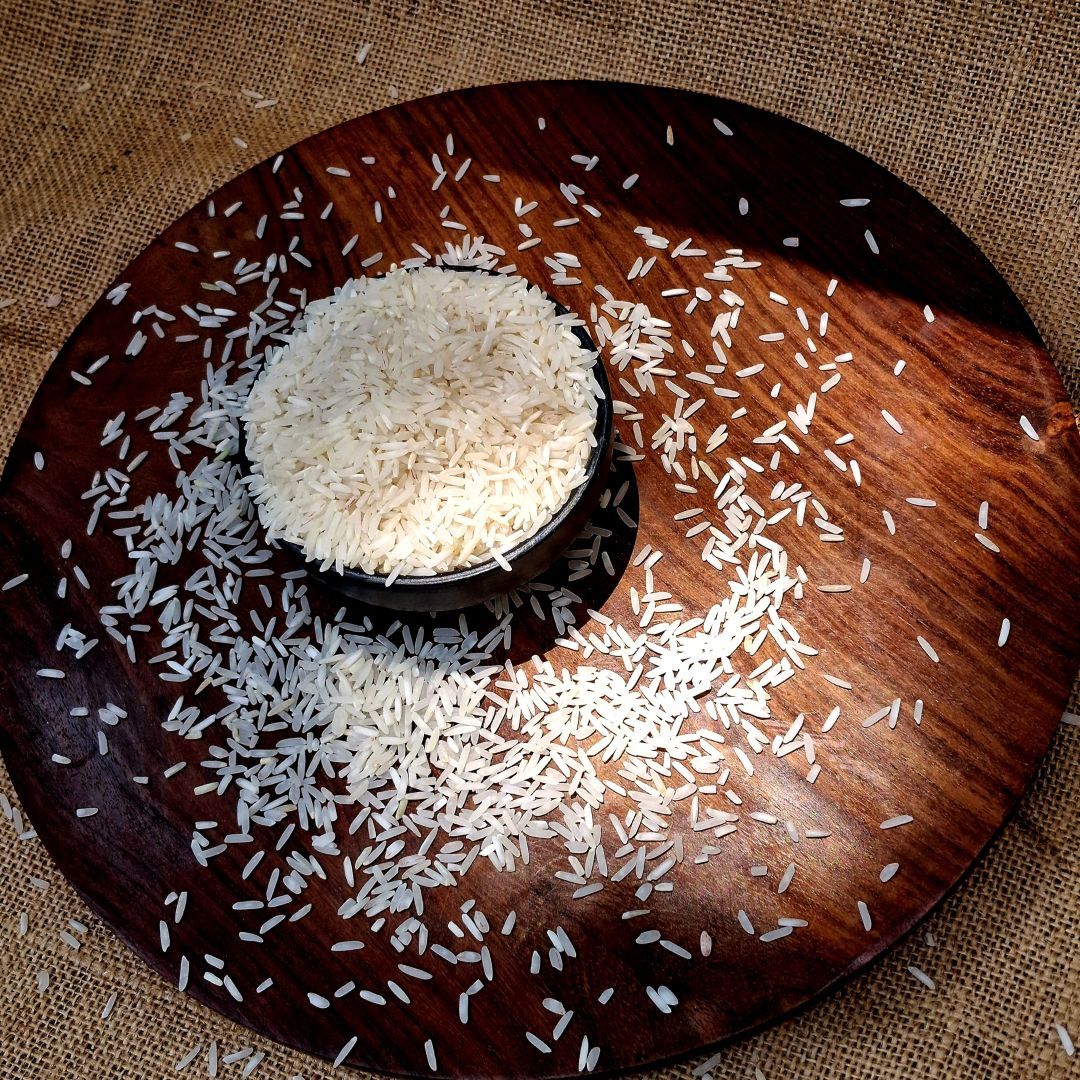
Rice Tarawadi Basmati White
SKU 98
₹440.00
Price incl. GST (5%) ₹20.95
Weight
In stock
1
Estimated delivery time
Local delivery: today after 10:00 AM, depending on your address
Customer reviews
Reviews only from verified customers
No reviews yet. You can buy this product and be the first to leave a review.
Rice Tarawadi Basmati White
Product Details
Brand: Sanesa Yourganic
Organic Tarawadi Basmati Rice - Traditional Basmati from Our Own Farm
A Traditional Basmati, Grown by Us
Some rice reaches your kitchen through a long and anonymous commodity chain. Our Organic Tarawadi Basmati Rice has a much shorter story: we grow it ourselves.
Cultivated organically on our own farm, Tarawadi, also commonly referred to as Taraori Basmati, is a traditional Basmati variety valued for its distinctive aroma, delicate flavor and elegant character on the plate.
Unlike rice selected primarily for extraordinary grain length, Tarawadi’s appeal is more complete and nuanced. Its charm lies in the balance of aroma, taste, texture and elongation, the qualities for which traditional Basmati has historically been prized.
After harvest, our paddy is processed on a mechanical sheller that works as close as practically possible to traditional hand-pounding. The rice is not subjected to an additional polishing process merely to create the unnaturally smooth, glossy appearance often associated with highly refined commercial rice.
The result is rice whose journey we know intimately, from the soil in which it grew to the grain that reaches your kitchen.
🌾 What Makes Our Tarawadi Basmati Special?
| Characteristic | Our Tarawadi Basmati |
|---|---|
| Variety | Traditional aromatic Basmati |
| Farm origin | Grown on our own organic farm |
| Grain character | Long, slender and elegant |
| Aroma | Rich, distinctive traditional Basmati fragrance |
| Taste | Delicate, flavorful and more pronounced than neutral everyday rice |
| Cooked texture | Separate, light and non-sticky when cooked correctly |
| Processing | Mechanically shelled; no additional polishing for artificial shine |
| Best suited for | Pulao, biryani, jeera rice, festive meals and flavor-led everyday meals |
Traditional Basmati varieties such as Taraori have long been recognized for quality characteristics distinct from newer varieties bred heavily around yield or exceptional kernel length. By comparison, PB1121 is particularly notable for its exceptional cooked-kernel elongation.
🍚 What About Its Glycaemic Index?
Basmati rice is often considered a more favorable rice choice from a glycemic perspective than many rapidly digested white rice varieties. However, GI is not a fixed number for all Basmati rice: it can vary with cultivar, starch composition, processing, ageing and cooking method.
The research report you shared is useful context. In PB1121 Basmati, the researchers reported a glucose-reference estimated GI of 58.41 for untreated rice, which fell to 54.67 and 54.31 after specific high-temperature soaking treatments. The study also found relatively high apparent amylose content and discussed the role of amylose characteristics in starch digestion.
For Sanesa’s Tarawadi, we therefore prefer the scientifically responsible description: lower to moderate GI potential, rather than claiming a precise GI number until the finished rice itself has been tested.
Sanesa note: Published Basmati studies have reported GI values around the mid-50s under certain varieties and processing conditions, but the actual GI of a meal depends on the rice variety as well as processing, cooking and meal composition.
I think this wording is commercially strong without overclaiming.
🌿 Grown by Us. Known by Us.
For most packaged rice, the relationship between the brand and the farm ends at procurement. With our Tarawadi Basmati, we know the farm because it is our own.
This gives us direct visibility over how the crop is grown and handled. Our objective is not to produce a grain that merely looks perfect under retail lighting; it is to grow rice with integrity and preserve as much of its natural character as possible through careful processing.
The absence of an additional polishing step may mean that the grains do not have the exaggerated shine of conventionally polished commercial rice. To us, that is not a cosmetic shortcoming - it is part of the product philosophy.
🆚 Which Sanesa Rice Should You Choose?
I would use the following comparison table. I have deliberately changed the GI column from precise numerical ranges to relative positioning, because comparable variety-specific GI testing is not available for all six of your actual finished products.
| Rice | Grain & Processing | Aroma | Taste & Flavour | Nutrition Positioning | GI Perspective* | Best For |
|---|---|---|---|---|---|---|
| Tarawadi Brown Rice | Wholegrain form with bran layer retained | Rich traditional Basmati aroma | Nutty, earthy and fuller-bodied | Highest fiber retention among the two Tarawadi forms | Potentially more favorable glycemic response than its white counterpart, but preparation matters | Health-focused meals, grain bowls, dal-rice |
| Tarawadi White Rice | Gently mechanically shelled; no additional polishing for shine | Rich and distinctive | Delicate, aromatic and refined | Easier texture with less fiber than brown rice | Lower to moderate GI potential at less than 55 | Pulao, biryani, jeera rice, special meals |
| Kala Namak Rice | Small-to-medium aromatic heritage rice | Very strong and distinctive | Deep, earthy and characterful | Heritage rice valued primarily for sensory character and diversity | No responsible exact GI claim available | Dal-rice, khichdi, traditional meals |
| 1121 Basmati Rice | Extra-long slender Basmati | Pleasant Basmati aroma | Clean, delicate and relatively subtle | Primarily distinguished by extraordinary grain length and elongation | Published PB1121 research places samples from the mid-50s to upper-50s depending on processing treatment | Biryani, pulao and presentation-led dishes |
| Red Choba Rice | Pigmented wholegrain rice | Mild, earthy | Robust, nutty and chewy | Bran and natural red pigmentation retained; strongest wholegrain nutrition | Likely slower-digesting meal format than refined white rice, but no exact GI available | Grain bowls, salads, hearty dal-rice meals |
| Sona Masuri Rice | Medium-grain everyday rice | Mild | Light, neutral and versatile | Everyday rice | GI can vary materially with processing and cooking | Daily meals, curd rice, lemon rice, sambar-rice |
*GI response can vary with cultivar, processing, ageing, cooking method, cooling and reheating, portion size, and the other foods eaten in the same meal.
For 1121 specifically, the distinction in the table is well supported: published research describes PB1121 as possessing extra-long slender grains and exceptional cooked-kernel elongation.
🥗 Nutrition Highlights
Because we do not have a laboratory report for the finished Sanesa Tarawadi White Rice, I would not put precise nutrient numbers into the table as though they were product-tested values. I recommend this format instead:
| Nutritional Characteristic | Perspective |
|---|---|
| Carbohydrates | Rice is predominantly a carbohydrate food and is best consumed in sensible portions as part of a balanced meal |
| Protein | Rice contributes a modest amount of plant protein |
| Fat | Naturally low in fat |
| Fiber | Lower than brown rice, but processing is deliberately kept gentle, and the rice is not additionally polished merely for shine |
| Sodium | Naturally very low in sodium before salt is added during cooking |
| Gluten | Rice is naturally gluten-free |
| Amylose & starch behavior | Basmati varieties are studied for starch characteristics associated with comparatively moderate glycemic responses, though results vary by variety and processing |
A note for people managing blood sugar
Rice portion size and the composition of the entire meal matter. Pairing rice with vegetables, pulses, protein and healthy fats generally creates a very different meal context from eating a large portion of rice alone. Customers managing diabetes or other medical conditions should follow personalized medical or dietary advice rather than rely on a variety name or a single GI number.
👨🍳 How to Cook Tarawadi Basmati Rice
For best results, rinse the rice gently until the water is reasonably clear. Soaking before cooking can help the grains cook more evenly and may improve elongation and texture.
For absorption cooking, start with approximately 1 part rice to 1.5-1.75 parts water, adjusting for soaking time, vessel and preferred texture. Cook on low heat after the initial boil, allow the rice to rest covered after cooking, and fluff gently with a fork.
For biryani or other dishes where the rice will undergo further cooking, parboil only to the stage appropriate for the final dum or finishing process.
🌾 An Interesting Fact
Tarawadi and Taraori refer to the same traditional Basmati identity in common trade usage, with the name associated with Taraori in Haryana’s historic Basmati-growing belt. Unlike PB1121, whose modern reputation is strongly connected with exceptional grain length and elongation, Tarawadi’s proposition is that of a traditional aromatic Basmati with a more heritage-led sensory identity.
🌱 The Sanesa Purity & Sustainability Promise
- 🌾 Farm-to-kitchen traceability: This Tarawadi Basmati is grown on our own farm, giving us direct visibility over its cultivation and handling.
- 🚫 No chemical farming inputs: Cultivated according to our organic farming standards.
- ⚙️ Gently processed: Mechanically shelled using a process intended to remain close to traditional hand-pounding.
- ✨ No polishing for cosmetic shine: We do not chase the artificial gloss commonly associated with aggressively refined rice.
- 🔬 Our wider 5-point purity approach: Certification, references, personal evaluation, taste profiling and laboratory testing form the framework through which Sanesa evaluates purity and quality.
- 🌍 Less anonymous sourcing: We believe food should come with a knowable origin, not merely a brand label and a batch number.
🚚 Same-Day Delivery of Organic Rice in Delhi NCR
Order Sanesa Organic Tarawadi Basmati Rice for home delivery across Gurugram, Delhi, Noida, Faridabad and Indirapuram.
For same-day delivery, orders can generally be placed before 4 PM in Gurugram and before 2 PM in Delhi, Noida, Faridabad and Indirapuram, subject to slot availability and operational conditions.
From Golf Course Road and DLF Phase 2 in Gurugram to Green Park and Kailash Colony in Delhi, and from Noida Sector 52 to Sector 137 and Jaypee Greens, Sanesa brings carefully sourced and organically grown food to homes across Delhi NCR.
Display prices in:INR