Trusted by Families Since 2017 • Naturally Ripened Organic Fruits, Organic Vegetables and more groceries • No-Questions-Asked Refunds
Pasta Multi Millet Khapli
SKU 00615
₹210.00
Price incl. GST (5%) ₹10.00
Weight
In stock
1
Have questions?
Customer reviews
Reviews only from verified customers
No reviews yet. You can buy this product and be the first to leave a review.
Pasta Multi Millet Khapli
Product Details
🌾 Organic Multi Millet Pasta - Foxtail, Barnyard, Jowar, Kodo & Khapli
Four Millets. One Ancient Wheat. One Seriously Satisfying Bowl.
Why choose one millet when you can bring several traditional grains to the same meal?
Our Organic Multi Millet Pasta is made with an equal 20% each of Kangani (Foxtail Millet), Samak (Barnyard Millet), Jowar (Sorghum), Kodo Millet and Khapli (Emmer) Wheat. There is no maida and no single grain added merely for its name on the label — 80% of the flour blend is millet.
The accompanying organic masala turns those rustic fusilli-style twists into the kind of warm, savory comfort bowl that can satisfy a Maggi-like craving, while the grain underneath couldn't be more different.
Every grain and spice used is certified organic.
🌿 What Sets Our Multi Millet Pasta Apart
- 🌾 80% Millet: four different millets, each contributing 20%
- 🌿 20% Khapli Wheat: ancient Emmer wheat for binding, structure and bite
- 🌈 Greater Grain Diversity: Foxtail + Barnyard + Jowar + Kodo in every pack
- 🚫 No Maida
- 🌶️ Comes with a simple organic masala tastemaker
- 🌱 All agricultural ingredients are certified organic
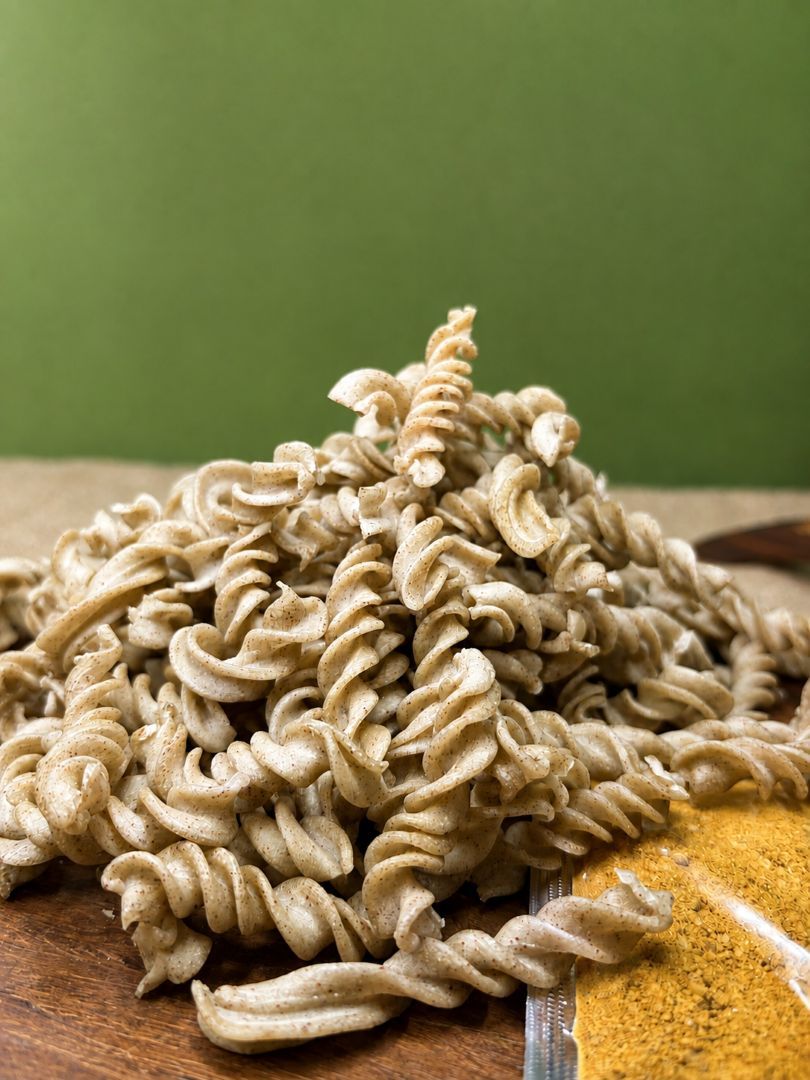
- 🍝 Rustic fusilli-style twists hold masala and sauces beautifully
- 🧾 A remarkably straightforward ingredient list
- 👨👩👧 An easy way to introduce several traditional grains into a familiar family meal
🌾 Five Traditional Grains in One Pasta
The point of this formulation isn't to pick a “best” millet. Different grains bring different nutritional and culinary characteristics, and dietary diversity itself is valuable.
Kangani / Foxtail Millet: 20%
An ancient small millet with a mild, subtly nutty character. Foxtail Millet naturally contributes fiber, protein and minerals and works particularly well in pasta because its flavor doesn't overpower the dish.
Samak / Barnyard Millet: 20%
A traditional small millet familiar across India, particularly through fasting foods. It adds another source of whole-grain fiber and mineral diversity to the blend.
Jowar / Sorghum: 20%
One of India's great dryland grains. Jowar contributes its characteristic earthy grain flavor alongside fiber and naturally occurring polyphenolic compounds.
Kodo Millet: 20%
A lesser-used traditional millet with a pleasantly earthy character. Kodo broadens the grain and plant-compound diversity of the blend.
Khapli / Emmer Wheat: 20%
An ancient wheat rather than a millet. Khapli serves an important functional purpose here: its gluten helps bind the four millet flours and gives the pasta enough structure to survive cooking while retaining its twists.
The result is a pasta that's 80% millet without pretending wheat isn't necessary for this particular formulation.
🥣 What's Inside?
Pasta
Kangani (Foxtail Millet) Flour 20% • Samak (Barnyard Millet) Flour 20% • Jowar (Sorghum) Flour 20% • Kodo Millet Flour 20% • Khapli (Emmer) Wheat Flour 20% • Salt
🌶️ Organic Tastemaker
Ingredients in descending order of quantity:
Dhania (Coriander) Seed Powder • Onion Powder • Garlic Powder • Salt • Red Chilli
That's it.
No need for an elaborate seasoning system. The tastemaker uses familiar organic spices to give you a warm, savory masala bowl while allowing the character of the grains to remain present.
👅 Taste & Texture Profile
| Characteristic | What to Expect |
|---|---|
| Taste | Nutty, mildly earthy and distinctly whole-grain |
| Aroma | Gentle roasted-grain character with warm spice notes once seasoned |
| Texture | Substantial, rustic bite; tender when properly hydrated |
| Pasta Form | Short, rustic fusilli-style twists |
| Masala Profile | Savory, aromatic and mildly spicy |
| Millet Content | 80% |
| Khapli Wheat | 20% |
| Maida | None |
| Gluten | Yes — from Khapli wheat |
🥗 Health Highlights - Diversity Over a Single “Supergrain”
There is a temptation to ask which millet is healthiest. We don't think that's the most useful way to look at this pasta.
This formulation combines four different millets rather than relying on a single cereal, giving you a broader grain profile in the same bowl.
Collectively, Foxtail, Barnyard, Jowar and Kodo millets naturally provide dietary fiber, protein, minerals and a range of naturally occurring plant compounds. Their individual nutritional profiles differ, which is precisely why combining them is interesting.
Most importantly, 80% of this pasta is millet rather than refined maida.
For someone trying to improve the quality of an everyday diet, the practical proposition is simple: more grain diversity, more traditional cereals, less dependence on routinely consumed refined flour — in a food the family already enjoys eating.
That is a more defensible reason to choose Multi Millet Pasta than treating any individual millet as a miracle food.
Note: Natural nutrient concentrations vary by grain, crop and batch. Please refer to the final nutrition panel for product-specific nutrient values and %RDA.
💧 Important: Multi Millet Pasta Needs More Water
This pasta behaves quite differently from conventional instant noodles.
With 80% millet, the flour blend contains considerably more fiber-containing grain material than a refined-maida product. Adequate hydration is therefore important for the spirals to become properly tender.
For one 170 g pack, use approximately 700 mL water.
If you're accustomed to making instant noodles with a relatively small quantity of water, don't use the same quantity here. Too little water can leave the thicker twists firm or unevenly hydrated.
The ~700 mL quantity is based on the cooking behavior of this formulation and is our recommended starting point.
🍳 How to Cook Multi Millet Pasta
1. Bring ~700 mL water to a boil
Use a wide enough pan to allow the pasta to move and hydrate evenly.
2. Add the pasta
Add the complete 170 g pack to the boiling water.
3. Cook gently
Allow the twists to soften, stirring occasionally to prevent sticking.
4. Add the tastemaker
Once the pasta has begun to soften, add the accompanying organic masala and mix thoroughly.
5. Continue cooking until tender
Let the pasta cook until the thicker twists are properly hydrated and the masala coats them well.
6. Rest briefly and serve warm.
💡 With Millet Pasta, Trust the Bite
Don't rely solely on a timer.
Take one of the thicker spirals out and taste it. If the center remains too firm, add a little more hot water and continue cooking.
Millet pasta needs enough hydration to become tender. Cooking it with too little water and then calling the resulting hardness “al dente” rather misses the point.
🍅 Make It a Proper Meal
The included tastemaker means you can make a simple masala Multi Millet Pasta straight from the pack.
But the spirals are an excellent base for vegetables. Try adding peas, carrots, capsicum, beans, mushrooms, spinach, broccoli or sweet corn. Add paneer or another protein if you're turning it into lunch or dinner.
For children, a little butter or ghee can mellow the spice and give the pasta a softer, rounder flavor.
And you certainly don't have to use the tastemaker. The grain blend works with fresh tomato sauce, pesto, sautéed vegetables, garlic and olive oil, or your own homemade pasta sauce.
⚠️ Caution
Four of the five grains in this formulation — Foxtail Millet, Barnyard Millet, Jowar and Kodo Millet — are naturally gluten-free.
The finished pasta, however, is NOT gluten-free because it contains 20% Khapli wheat.
It is therefore not suitable for people with coeliac disease or anyone medically required to avoid gluten.
Similarly, “multi millet” should not be interpreted as carbohydrate-free or automatically low-GI. These are still cereal grains. Processing, cooking, portion size and the foods eaten alongside the pasta all influence the metabolic response to the finished meal.
🌱 Our Sustainability & Service Promise
- 🌾 80% Millet: Four traditional millets make up the overwhelming majority of the flour blend.
- 🌿 Certified Organic: All agricultural ingredients come from certified organic cultivation.
- 🚫 No Maida: No refined wheat flour in the pasta.
- 🌶️ Simple Organic Tastemaker: Dhania, onion, garlic, salt and red chili.
- 🌱 Crop Diversity: Four millet species in one product means demand isn't concentrated on a single cereal.
- 💧 Resilient Grains: Millets are particularly valuable in agricultural systems facing water and climatic constraints.
- 🌾 Beyond Rice & Wheat: Supporting millets helps broaden both our diets and the crops farmers have a market for.
- 🤝 Sanesa assurance: Backed by our commitment to genuinely organic and chemical-free food.
💡 Fun Fact
This pasta contains four different millets, but only 20% wheat.
That 20% Khapli performs an outsized job: its gluten provides the structural network that helps bind the four gluten-free millet flours into twists that can actually hold together in boiling water.
So Khapli isn't filler here. It's the structural supporting act that lets the four millets remain the stars.
🚚 Organic Groceries Delivered to Your Doorstep
Fast NCR Delivery: We offer same-day delivery across Gurgaon for orders placed before 4 PM, and across Delhi, Noida, Faridabad and Indirapuram for orders placed before 2 PM.
Whether you're in Greater Kailash or Hauz Khas in Delhi, DLF Phase 4 or Golf Course Extension Road in Gurgaon, get Sanesa Yourganic's range of certified organic millets, grains, groceries and fresh produce delivered to your doorstep.
🔎 Search Keywords
organic multi millet pasta, mixed millet pasta India, 80% millet pasta, Foxtail Millet pasta, Barnyard Millet pasta, Jowar pasta, Kodo Millet pasta, Khapli wheat pasta, millet fusilli India, healthy pasta without maida, no maida pasta, organic millet pasta Delhi NCR, multi grain pasta India, millet pasta for kids, healthy masala pasta, certified organic pasta, organic pasta Gurgaon
Display prices in:INR