Trusted by Families Since 2017 • Naturally Ripened Organic Fruits, Organic Vegetables and more groceries • No-Questions-Asked Refunds
Black Rock Salt (Kala Namak)
SKU 72
₹65.00
Price incl. GST (5%) ₹3.10
Weight
In stock
1
Estimated delivery time
Local delivery: today after 10:00 AM, depending on your address
Customer reviews
Reviews only from verified customers
No reviews yet. You can buy this product and be the first to leave a review.
Black Rock Salt (Kala Namak)
Product Details
UPC: 684779293
Brand: Sanesa Yourganic
🖤 Traditional Black Rock Salt (Kala Namak) - Kiln-Fired in Earthen Matkas
Authentic Indian Kala Namak | Traditionally Prepared with Harad & Other Ingredients | Slow-Fired & Finely Milled
Black Rock Salt, popularly known as Kala Namak, is much more than ordinary rock salt with a different color. Its unmistakable tangy, savory flavor and sulphurous aroma come from a fascinating traditional preparation process involving rock salt, carefully selected ingredients, earthen matkas and intense kiln firing.
Our Black Rock Salt is prepared following the traditional Indian method, in which rock salt is combined with Harad and other ingredients traditionally used in making Kala Namak. The mixture is heated inside earthen matkas, allowing high temperatures to transform the salt's color, composition, aroma and flavor.
Once the firing is complete, the salt is allowed to cool and solidify into a hard, rock-like mass. The earthen matkas are then broken open, and the resulting Black Rock Salt is milled into fine granules.
The result is authentic Kala Namak with its characteristic tanginess, savory depth and familiar boiled-egg-like aroma, a flavor that ordinary Pink Rock Salt simply cannot replicate.
✨ Why Choose Our Black Rock Salt?
- 🏺 Traditionally Matka-Fired: Prepared in earthen pots using a time-honored Indian salt-making process rather than merely mixing salt with flavoring powders.
- 🌿 Prepared with Traditional Ingredients: Harad and other ingredients are used according to traditional Kala Namak preparation methods.
- 🔥 Kiln-Fired Transformation: Intense heating develops the distinctive sulphur compounds responsible for Black Salt's aroma, taste and appearance.
- 🪨 Cooled & Solidified: After firing, the salt forms a hardened crystalline mass before being broken out of the earthen matkas.
- ⚙️ Finely Milled: The solidified salt is ground into convenient fine granules for everyday culinary use.
- 🍋 Distinctive Tangy & Savory Taste: Perfect for enhancing chaat, raitas, fruit salads, chutneys and traditional Indian drinks.
🏺 How Is Our Traditional Black Rock Salt Made?
Unlike Pink Rock Salt, which can be used after washing and milling, Black Rock Salt undergoes an additional, high-temperature transformation that gives it a completely different character.
1. 🧂 Preparing the Rock Salt
Rock salt forms the foundation of the preparation. It is combined with ingredients used in the traditional process of making Kala Namak.
2. 🌿 Combining Traditional Ingredients
Harad and other traditional preparation materials are mixed with the salt. The particular combination of ingredients is an important part of the traditional recipe.
3. 🏺 Filling the Earthen Matkas
The prepared mixture is placed inside earthen pots, or matkas, which are arranged in a kiln for firing.
4. 🔥 Kiln Firing
The matkas are subjected to intense heat. During this stage, the salt undergoes chemical transformations, developing the sulphur-containing compounds that give Kala Namak its characteristic flavor and aroma.
5. 🪨 Cooling & Solidification
Following firing, the mixture is allowed to cool and settle. As it cools, the salt solidifies into a hardened crystalline mass.
6. ⚙️ Breaking & Milling
The earthen matkas are broken open to recover the Black Rock Salt. The hardened salt is then milled into fine granules, ready to season your favorite dishes.
What makes this preparation special is the transformation itself: the salt's distinctive flavor develops during firing, rather than simply from ingredients mixed into an already finished seasoning.
🌿 Nutritional Information & Traditional Wellness Uses
Kala Namak consists primarily of sodium chloride, along with smaller quantities of sulphur-containing compounds and other mineral constituents.
- 🧂 Sodium: An essential electrolyte involved in maintaining fluid balance and supporting normal nerve and muscle function.
- 🌋 Sulphur Compounds: Responsible for Black Salt's characteristic aroma and savory taste.
- ⚖️ Trace Minerals: May contain varying amounts of iron, potassium, calcium and magnesium, depending on the salt and manufacturing process.
- 🌱 Zero Calories: Like other edible salts, Kala Namak contributes virtually no calories, carbohydrates, fats or proteins.
🌿 Traditional Ayurvedic Perspective
Black Salt has a long history in Indian culinary and Ayurvedic traditions, particularly in preparations associated with appetite and digestion.
Ingredients such as Harad also hold an important place in traditional Ayurvedic formulations. However, their use during Black Salt manufacture does not establish that the finished salt retains their medicinal properties.
A note on sodium: Black Rock Salt is not a low-sodium alternative to regular salt. Like all edible salts, it should be consumed in moderation. It should also not be relied upon as a significant source of dietary minerals or iodine.
🍴 Culinary Uses - Bring Traditional Indian Flavors to Your Kitchen
Kala Namak's distinctive taste makes it especially valuable in preparations where ordinary salt cannot provide the same complexity.
- 🥭 Fresh Fruits & Fruit Chaat: Sprinkle over guava, papaya, watermelon, mangoes and other seasonal fruits.
- 🥣 Raita & Dahi Preparations: Adds a familiar savory dimension to cucumber raita, boondi raita and dahi bhalla.
- 🥗 Chaat & Salads: Essential in aloo chaat, chickpea chaat, sprouts, cucumber salads and homemade chaat masala.
- 🍋 Nimbu Pani & Jaljeera: Brings the classic tangy, salty character to refreshing Indian drinks.
- 🌱 Vegan & Plant-Based Cooking: Ideal for tofu bhurji and egg-free preparations where a mildly egg-like aroma is desired.
- 🥔 Everyday Snacks: Try a pinch over roasted makhana, boiled sweet potatoes, homemade chutneys or freshly cut vegetables.
💡 Culinary Tip: Use Kala Namak sparingly, particularly as a finishing salt. Start with a small pinch and adjust to taste. Its characteristic sulphurous aroma can easily dominate delicate flavors.
💡 Fun Fact - Why Is Kala Namak Called Black Salt When the Powder Looks Pink?
Here's something many people don't realize: authentic Kala Namak does not necessarily look black once ground!
During traditional kiln firing, chemical reactions produce sulphur-containing compounds and iron sulphides, which contribute to the salt's characteristic aroma and dark color.
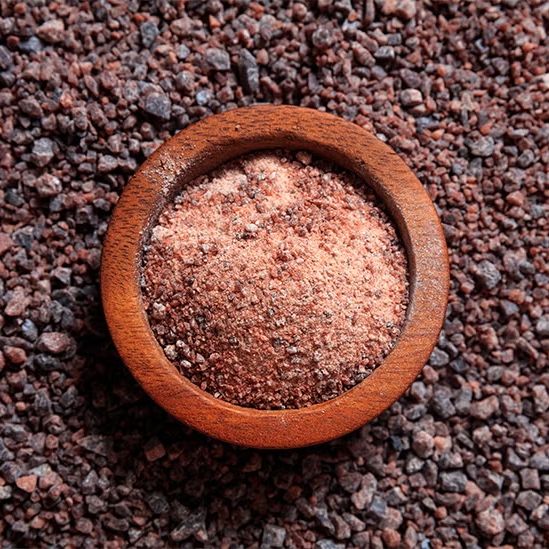
In larger crystalline chunks, Kala Namak may appear dark brown, violet or nearly black. But when those same crystals are finely milled, the powder often looks pinkish-grey, purple or even pale pink.
That familiar boiled-egg-like smell also has a scientific explanation: it comes primarily from trace amounts of hydrogen sulphide.
So, if your Black Rock Salt looks pinkish rather than jet black, that alone is no reason to question its authenticity!
🧂 Pink Rock Salt vs Black Rock Salt - Key Differences
| Feature | 🩷 Pink Rock Salt | 🖤 Black Rock Salt |
|---|---|---|
| Preparation | Washed and milled | Traditionally kiln-fired in earthen matkas |
| Ingredients | Rock salt | Rock salt with traditional preparation ingredients |
| Color | Light pink to reddish | Dark crystals, often pinkish-grey when finely ground |
| Taste | Clean, mild saltiness | Tangy, savory and sulphurous |
| Aroma | Relatively neutral | Distinctive boiled-egg-like aroma |
| Best Uses | Daily cooking, brines and seasoning | Chaat, raita, fruits, chutneys and finishing |
| Processing | Physical cleaning and milling | Heat-induced chemical transformation followed by milling |
| Sodium Content | Substantial | Substantial |
Which one should you choose?
For everyday seasoning where you want a relatively neutral taste, choose Pink Rock Salt.
For chaat, fruit salads, raitas, traditional Indian drinks or recipes that benefit from a distinctive tangy flavor, choose Black Rock Salt.
📦 Packaging & Storage
- Keep in a cool, dry place in an airtight container.
- Always use a dry spoon to prevent moisture-related clumping.
- Protect from direct exposure to steam and humidity.
- A mild sulphurous aroma is a normal characteristic of Kala Namak and not a sign of spoilage.
🌍 Our Sustainability & Service Promise
- 🌿 Respect for Traditional Craft: We value food-making practices rooted in Indian culinary heritage, including the traditional preparation of Kala Namak in earthen pots.
- 🏺 Traditional Processing: The salt undergoes an involved process of mixing, firing, cooling, breaking and milling.
- 🤝 Thoughtful Sourcing: We work closely with our suppliers to understand the origins and preparation of the foods we offer.
- ♻️ Responsible Packaging: We seek to minimize unnecessary packaging and encourage customers to return eligible reusable boxes, bottles and jars through our buyback programme.
- 📲 Customer Care: Our team is available for product queries, storage guidance, culinary suggestions and order-related assistance.
🚚 Buy Traditional Black Rock Salt Online - Same-Day Delivery in Delhi NCR
Fast NCR Delivery: We know good ingredients deserve convenient access. That's why Sanesa Yourganic offers same-day delivery in Gurgaon (orders before 4 PM) and Delhi, Noida, Faridabad and Indirapuram (orders before 2 PM).
Whether you live in Greater Kailash, Vasant Vihar or Defence Colony in Delhi; DLF Phase 4, Golf Course Road or Nirvana Country in Gurgaon; or Sector 44, Sector 50 or Sector 93 in Noida, get traditionally prepared Black Rock Salt delivered to your doorstep along with your favorite organic groceries.
Experience the distinctive flavor of authentic Indian Kala Namak in everyday cooking.
❓ Frequently Asked Questions
Is Black Rock Salt naturally black?
Not necessarily. Traditional Kala Namak develops its darker color through kiln firing. When finely milled, it may appear pinkish-grey or violet.
Is Black Rock Salt the same as Pink Rock Salt?
No. Although rock salt can be the starting material for both, Kala Namak undergoes additional high-temperature processing that changes its flavor, aroma and color.
Why does Black Salt smell like boiled eggs?
Its characteristic aroma comes primarily from sulphur-containing compounds formed during preparation, particularly hydrogen sulphide.
Is Kala Namak healthier than regular salt?
Kala Namak has a different flavor profile, but it still contains substantial sodium. There is insufficient evidence to recommend it over regular salt for better blood pressure control or other specific health outcomes.
Can Kala Namak be used for everyday cooking?
Yes, although its pronounced flavor makes it especially suitable for finishing dishes, chaat, raitas, fruits and traditional drinks.
🗣 Multilingual Names
- Hindi: काला नमक (Kala Namak)
- Punjabi: ਕਾਲਾ ਨਮਕ
- Bengali: বিট লবণ / কালো নুন
- Gujarati: સંચળ (Sanchal)
- Marathi: काळे मीठ (Kale Meeth)
- Tamil: கருப்பு உப்பு (Karuppu Uppu)
- Telugu: నల్ల ఉప్పు (Nalla Uppu)
- Kannada: ಕಪ್ಪು ಉಪ್ಪು (Kappu Uppu)
- Malayalam: കറുത്ത ഉപ്പ് (Karutha Uppu)
- English: Indian Black Salt / Kala Namak / Black Rock Salt
Display prices in:INR